
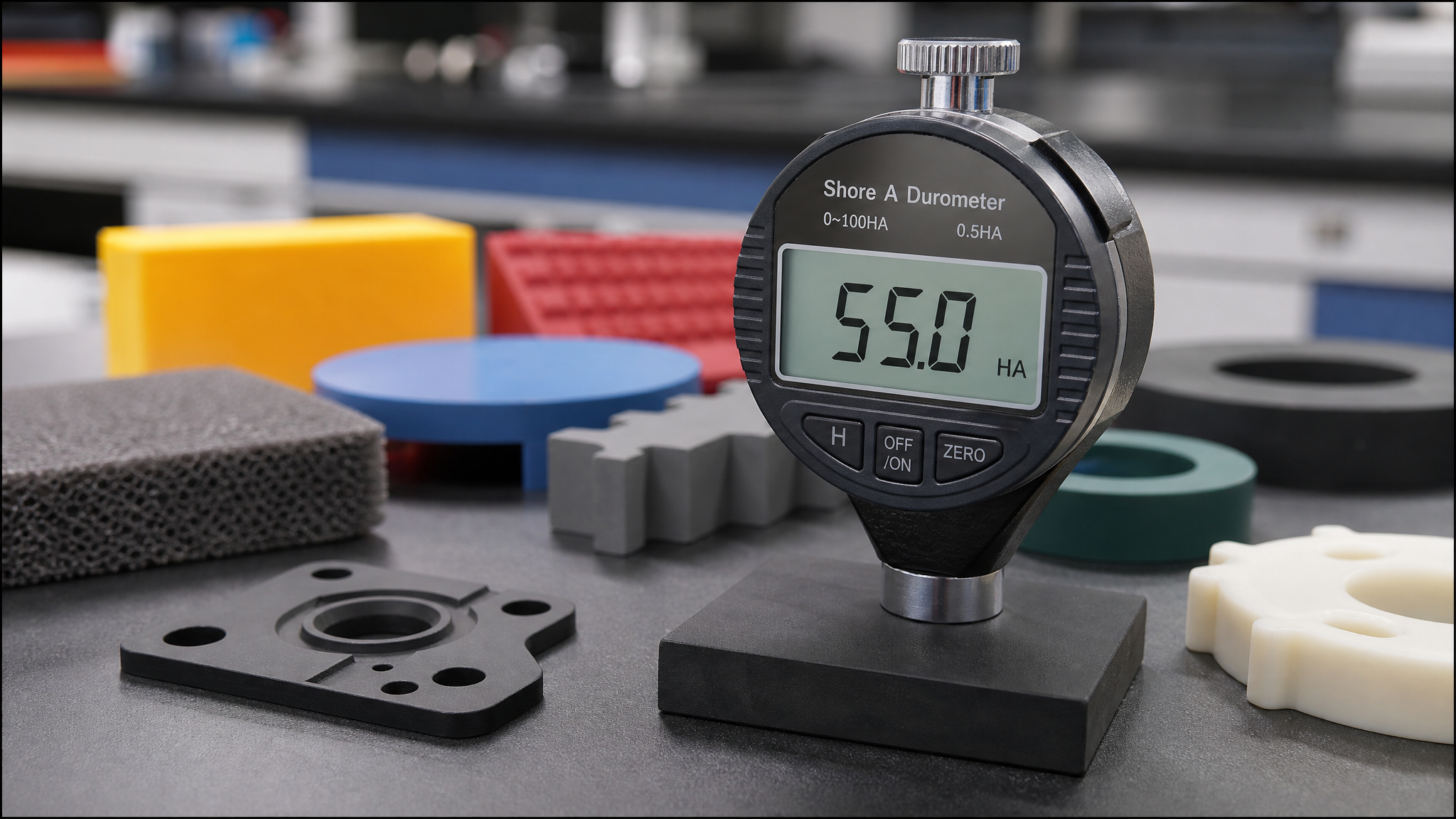
The ultimate guide to Shore A, C, and D hardness scales. Learn how to select the right durometer for O-rings, healthcare foam, and industrial plastics to ensure performance and comfort.
The Language of Touch: Why "Soft" Isn't a Specification
In industrial design, "soft" or "hard" are subjective terms that lead to production errors. To achieve precision, engineers rely on Shore Hardness (Durometer). Whether you are designing a high-pressure hydraulic seal or an ergonomic surgical cushion, selecting the correct scale is the first step toward structural integrity and user comfort.
1. Understanding the Scales: A, C, and D
Shore hardness measures the resistance of a material to indentation. The three most common scales in our industry are:
Shore A (Flexible Elastomers): The standard for soft rubbers, silicones, and TPU. It uses a blunt indenter.
Shore C (Medium Foams): Specifically designed for micro-cellular materials like self-skinning PU foam. It uses a larger ball indenter to avoid piercing the "skin."
Shore D (Rigid Plastics): Used for hard rubbers and semi-rigid plastics (like Nylon or hard PU). It features a sharp, needle-like indenter.
2. Case Studies: The Right Tool for the Job
The 70A Standard for Hydraulics
Why is Shore 70A the industry standard for O-rings? It strikes the perfect balance: it is soft enough to deform and create a seal under low pressure, yet hard enough to resist extrusion into clearance gaps under high hydraulic pressure.
The 40C Comfort for Healthcare
For healthcare cushions and armrests, Shore 40C self-skinning foam is the gold standard. It provides the "soft-touch" comfort required for long-term patient contact while maintaining a high-density skin that is durable and easy to disinfect.
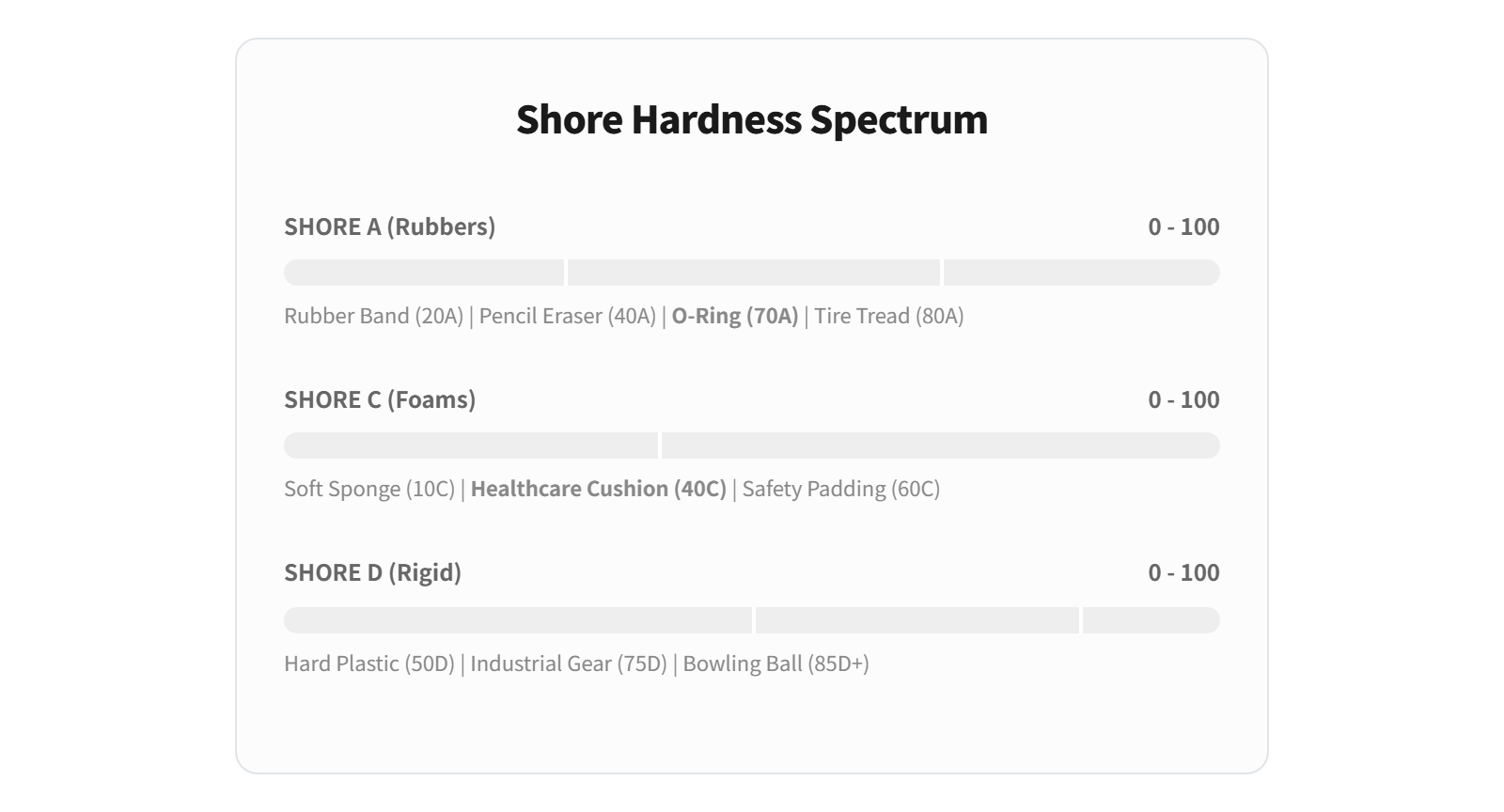
3. Cross-Material Hardness Comparison (Widget)
This visual guide helps you map where common products fall across the different Shore scales:
4. Why Accuracy Matters for B2B Sourcing
Specifying the wrong hardness leads to catastrophic failure. A seal that is too hard will crack; a cushion that is too soft will bottom out. As a high-precision manufacturer, we provide Shore A ±5 tolerance control, ensuring that your parts perform exactly as engineered.
Confused between Shore A and Shore D? Our technical team can help you select the optimal durometer for your specific environment. Consult Our Engineering Team Today.
Q: Can Shore A be converted to Shore D?
A: Yes, there is an overlap. Typically, 90 Shore A is equivalent to approximately 40 Shore D. However, testing should always be done on the specific scale intended for that material.
Q: How do you test the hardness of a finished part?
A: We use a calibrated Durometer. The device is pressed against a flat surface of the material for a specific dwell time, and the resistance is read from the dial or digital display.