
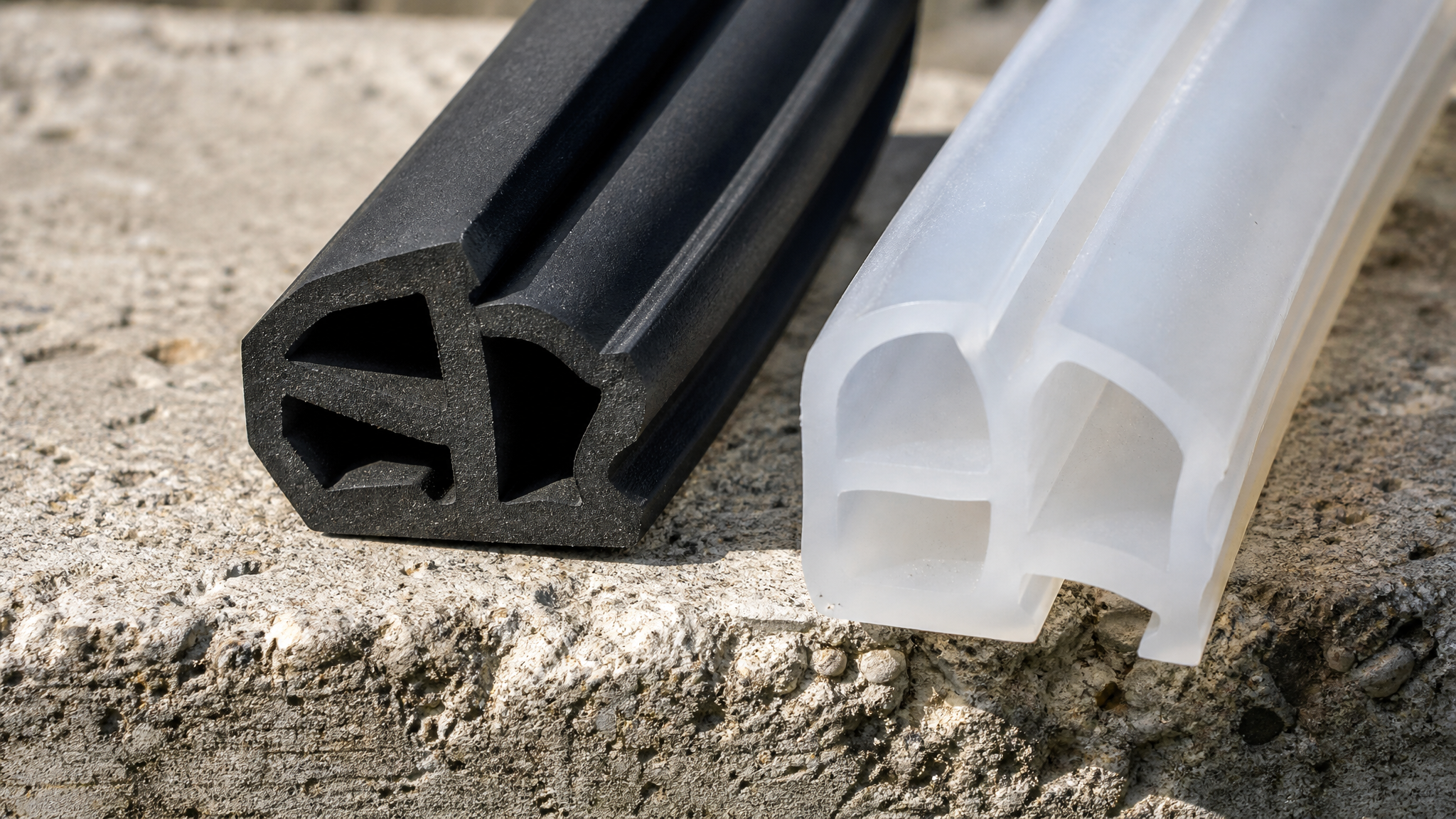
EPDM vs. Silicone: A technical guide for industrial outdoor sealing. Compare UV resistance, temperature ranges, and compression set to ensure a 25-year service life for your infrastructure
The 25-Year Challenge: Beyond the Surface
In outdoor infrastructure—from solar panel gaskets to bridge expansion joints—a seal is expected to last 20 to 25 years. Failure is not an option. However, procurement often faces a dilemma: Should you pay a premium for Silicone, or is EPDM the smarter choice? The answer lies in the chemistry of environmental stress.
1. The Chemistry of Resistance: Carbon vs. Siloxane
The fundamental difference starts at the molecular level:
EPDM (Ethylene Propylene Diene Monomer): Built on a Carbon-Carbon (C-C) backbone. This structure is exceptionally resistant to outdoor aging, ozone, and UV radiation, making it the "weathering champion."
Silicone (VMQ): Features a Silicon-Oxygen (Si-O) bond. This bond is much stronger than the Carbon-Carbon bond, providing unrivaled stability at extreme temperatures, though it is more susceptible to mechanical tearing.
2. Temperature Extremes: Where Silicone Dominates
If your application involves fire, ice, or high-intensity friction, Silicone is non-negotiable.
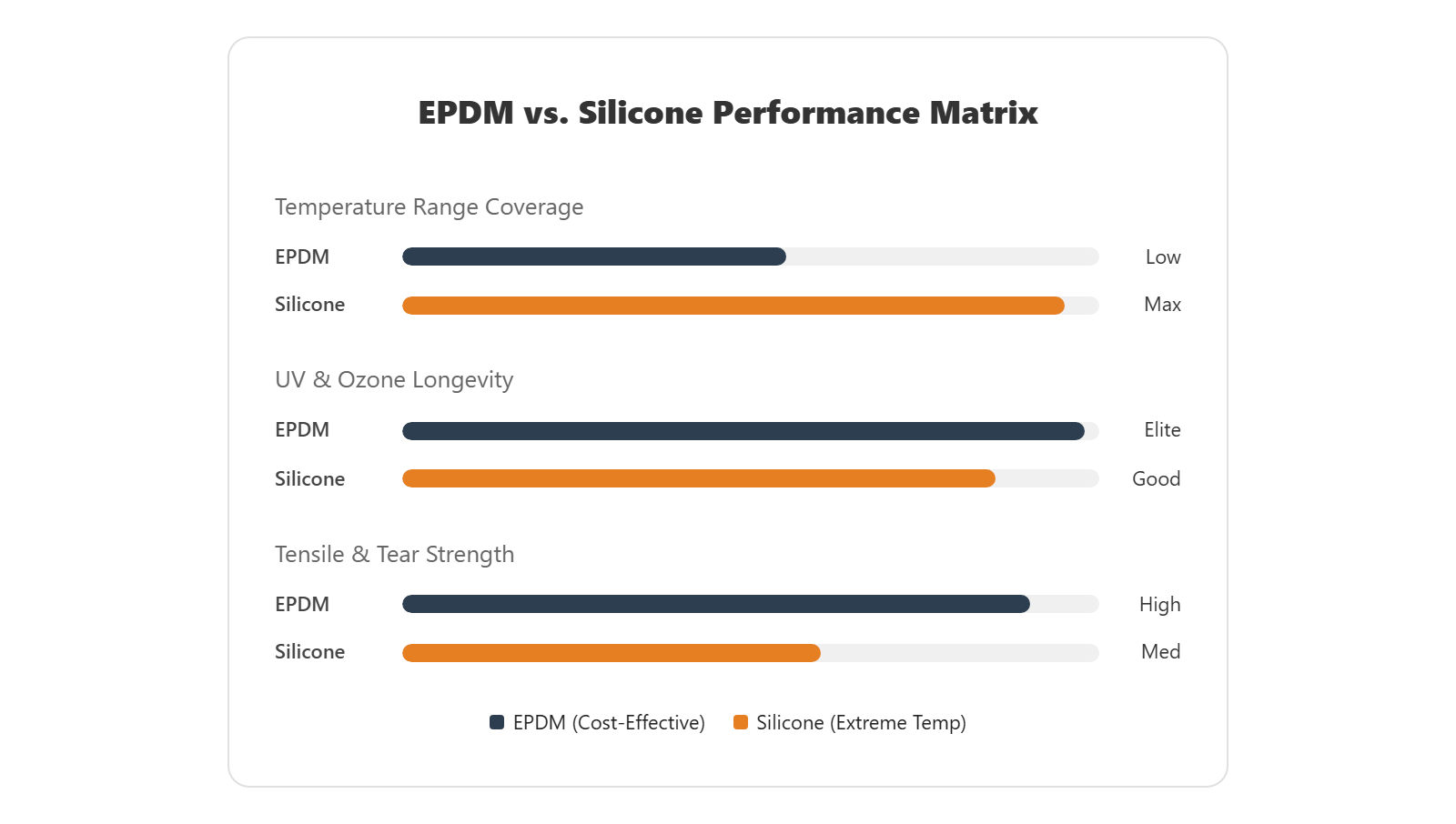
Silicone Range: Stable from -60°C to +230°C. It remains flexible in arctic cold and won't melt or harden in desert heat.
EPDM Range: Typically functional from -40°C to +120°C. While excellent for standard Earth environments, it will become brittle if exposed to extreme heat for prolonged periods.
3. Weathering & ROI: Why EPDM Rules Infrastructure
For most construction and infrastructure projects, EPDM offers a superior ROI.
UV & Ozone Resistance: EPDM is inherently resistant to the "cracking" caused by sun exposure. It is the gold standard for window seals, roofing membranes, and automotive weatherstripping.
Tensile Strength: EPDM generally offers higher tensile strength and abrasion resistance than Silicone. It can withstand the physical rigors of installation and structural movement better than its softer counterpart.
4. Technical Performance Matrix (Widget)
To help your engineering team make the final call, here is a data-driven comparison of key physical properties:
5. Conclusion: The Final Verdict
For 90% of outdoor industrial sealing applications where temperature stays between -40°C and +120°C, EPDM is the logical winner due to its durability and cost-effectiveness. However, for specialized food-grade applications or environments with extreme temperature spikes, Silicone remains the only viable solution.
Need a custom extruded profile or O-ring? Our engineers specialize in both EPDM and Silicone formulations tailored for 25-year service lives. Request a Material Comparison Sample Kit?Contact us: whatsapp+86 13356360481
Q: Can EPDM be used in food processing?
A: While EPDM is available in FDA-compliant grades, Silicone is generally preferred for food contact due to its chemical inertness and higher temperature resistance during sterilization cycles.
Q: Which material has a better compression set?
A: Both materials offer excellent compression set properties. However, high-grade Silicone typically maintains its seal pressure better over long periods of extreme heat compared to EPDM.